
Defining "progress studies"
The need for a new transdisciplinary approach

Why should we look back to move forward?
As a teenager in the 1990s in Bulgaria, I got my first exposure to Western culture. We suddenly had Cartoon Network, MTV, and Discovery Channel. The whole family was wrestling for control of the remote control (no pun intended). While my sister and I shared much the same interests in entertainment, our father was different: he loved watching historical documentaries. That didn’t make sense to my teenage brain: the current world around us was fascinating, and the future was bright. What was so interesting and important in black-and-white depressing Ken Burns documentaries? Several decades later, I found the answers and changed my perspective.

I eventually came to understand that there are two reasons why he would do that. The first one - he and my mother, having lived their lives till that point under the Iron Curtain, wanted to see the other point of view, the Western one, and that new interpretation of historical and current events. But the second one is more relevant here: he already knew that history repeats itself, and only by looking back can we know where we are going. We have to learn our lessons from the past as we approach new significant forks in the road ahead.
Forks in the road
Today, many of us feel like we are at a crossroads again. Our world is changing exponentially and growing in complexity. Cause and effect are blurred, and deducing patterns that can guide our understanding becomes increasingly challenging. Our culture is complex, and we live in a post-truth world1. While individual fields such as history, economics, and philosophy provide answers to match the complexity of our environment, we need to establish a more integrated, transdisciplinary field.
“Progress studies” was first mentioned in an article by Patrick Collison and Tyler Cowen in The Atlantic in 2019 (see the resources below), and I will critique current works in a future article. But I propose the following first definition:
Progress studies is an interdisciplinary field that draws on history, complexity science, and philosophy to understand, accelerate2, and sustain human progress across social, economic, scientific, and technological domains.
As with any new field, it will change, adapt, and get new flavors; mine is just one. But the essential foundation is there, with the key idea that no fundamental progress is possible without the three pillars (which are mutually exclusive and collectively exhaustive):
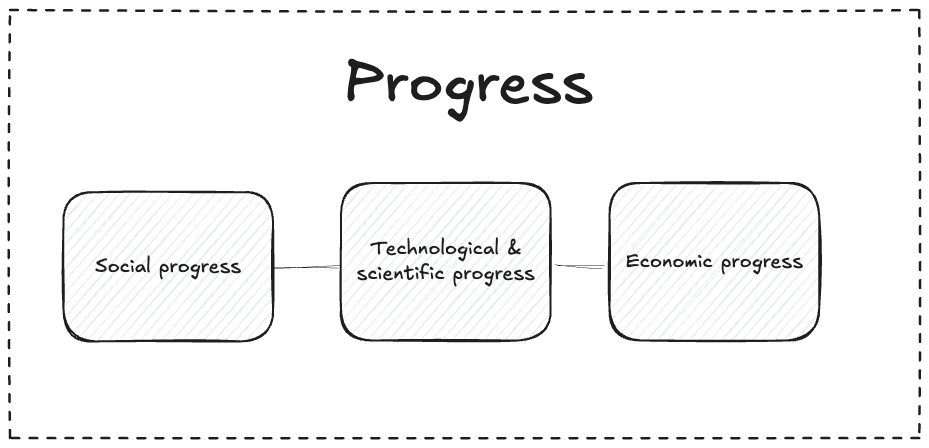
Many questions remain to be answered, such as why we should care about progress, how to measure it, and what previous attempts have been made. I hope to answer these and many more in this Substack and my new book.
Resources
Note: The resources provide important context to my arguments, but I do not necessarily agree with them.
I recognize culture as a fundamental force in driving or resisting progress, and I’ll return to the topic with more examples.
Note that “accelerate” can be a dangerous word since it is used in the philosophical movement of accelerationism, a critique of which I’ll provide in a future post.